In the United States, insurance coverage for autism services such as Applied Behavior Analysis (ABA), speech therapy and other services, varies by state. A number of Autism Bulletin readers have written recently asking how to find information about health insurance coverage in their area. Here are some tips:
1.) Get in touch with autism advocacy groups in your state.
There are power in numbers when advocating for public policy changes, and advocacy groups such as the Autism Society of America and Autism Speaks have chapters in many areas around the nation. Even if the chapter in your state or metropolitan area doesn't have any one working on this issue, you can ask them if they know someone who is.
There is an active national network of advocates working on this issue and it pays to tap into their experience. For example, a group in Arizona has been advocating for autism insurance coverage and worked with Autism Speaks to create a document listing the reasons it makes sense, both economically and from a public policy perspective.
These groups can also help you understand what the state law is right now in your state. Some states, such as South Carolina and Texas, have passed laws that require health insurance plans to provide some coverage for autism services. You can read about a number of these states by looking at the Autism Bulletin archives on health insurance issues, or using the search box.
2.) Check with your health insurance provider about specific policies and terms that apply to your family's claims.
You should understand what coverage you have now, and what limits there may be for that coverage. For example, some health maintenance organizations may limit the number of occupational therapy visits a patient is allowed to claim; once you reach that limit, payments for every visit after that could need to come out of your pocket.
Side note: while you are waiting for policies to change, you can check to see if your employer offers an arrangement called a medical flexible spending plan. This is a federal tax policy which allows you to set aside money from your paycheck, up to $5,000 per year, for medical expenses. You can use this "pre-tax" money to pay for autism services. The effect is to stretch some of your dollars to pay for these services. The Internal Revenue Service has an information page here. And make sure to review with your tax adviser what using this money means for your income tax returns.
3.) Call your state representative and ask what's going on.
Armed with information from advocates and your health insurance policy, get in touch with your state representative or state senator to let them know you are interested in what's going on with insurance coverage for autism.
Understand that a number of states have set up special commissions to study the issue of autism spectrum disorders, as a first step to figuring out what to do. So you can ask if your state has done one of these studies, and where to find a copy.
Some states have legislators who have personal experience with autism spectrum disorders. Every state should have lawmakers who care about healthcare, special education, and/or people with disabilities. So if you find no help at your state representative's office, figure out who may give you a more sympathetic hearing. Just be aware that insurance companies and people who disagree with you are doing the same thing.
Project Vote Smart has a very helpful website that helps you find your elected representatives by your Zip Code.
4.) Be an engaged citizen and participate in our democracy.
All of these steps involve paying attention and being willing to get involved in a political discussion. It's easy to feel like there's not much any one family, any one parent can do, to help move the global or national needle on autism services. But as the saying goes, many hands make a big load lighter.
So read the news. Ask questions. Find others who care about this issue and talk about it with them. And see what happens.
Observers of this issue also will note that while representatives of the insurance and business lobbies have lined up to oppose more insurance coverage for those with autism in states like Pennsylvania and Texas, this is not a partisan issue. All you have to do is read about South Carolina, where a Republican lawmakers overrode the governor's veto in 2007 to pass autism insurance legislation. And who led the charge, to get them to do that?
Three families, led by three moms.
Showing posts with label how to. Show all posts
Showing posts with label how to. Show all posts
Saturday, May 03, 2008


Monday, February 18, 2008
Special Series of Articles for Parents, Families New to Autism Diagnosis
BabyZone.com, a website for parents of young children, has just published a four-article series I wrote to help parents and families who are new to autism spectrum disorders—what autism is, what it means for their families, how to find ways to help their children. You can find the links to all four articles below:
What to Do When Your Child Gets an Autism Diagnosis
When your child receives an autism diagnosis, there are many more questions than answers about what it means and what you need to do. Here's how to start the effort to help your child grow and develop—and how to make sure you take care of everyone in your family (yourself included). More
Understanding Autism Spectrum Disorders
Experts like to point out that no two children with autism are quite alike. While that lack of clarity can be frustrating for parents, it demonstrates that researchers and doctors continue to refine their understanding of autism. Here is brief description of the places on the autism spectrum. More
Because autism is a serious disability, and early intervention so important, families tend to do as much for their diagnosed children as they can fit into their lives and budgets. Here is a guide to the most well-known treatments and techniques for helping young children with autism make developmental gains, along with advice for evaluating these approaches and resources to find more information. More
Autism Spectrum Disorders: Finding Support & Resources
If your child was recently diagnosed with an autism spectrum disorder or you're just looking for support and advice from families in similar situations to yours, read on. More
Saturday, February 16, 2008
A Basic Guide to Well-Known Autism Therapies
BabyZone.com, a website for parents-to-be and parents of young children, has published another article I wrote to help parents and families who are new to navigating the world of autism services.
You can find the article here: A Basic Guide to Well-Known Autism Therapies. The article notes:
You can find the article here: A Basic Guide to Well-Known Autism Therapies. The article notes:
Because autism is a serious disability, and early intervention so important, families tend to do as much for their diagnosed children as they can fit into their lives and budgets. Here is a guide to the most well-known treatments and techniques for helping young children with autism make developmental gains, along with advice for evaluating these approaches and resources to find more information.
The article includes information on many services families consider to help their kids, with links to other articles and organizations which can provide more information on each kind of service. The article's sections include:
- The Calculations Families Must Make
- Therapy Questions to Consider
- Applied Behavior Analysis
- TEACCH
- DIR/ Floortime
- Speech Therapy
- Occupational Therapy
- Relationship Development Intervention
- Special Diets & Other Alternative Treatments
- Social Stories & Other Communication Tools
Please note that people have written books about each of these subjects above; this article is designed to provide families confronting an autism spectrum disorder diagnosis with useful information. It's an effort to help families get started on their efforts to help their child.
Thursday, January 03, 2008
What to Do When Your Child Gets an Autism Diagnosis
BabyZone.com, a website site for parents of very young children, has published an article I wrote to help parents new to autism spectrum disorders understand what the diagnosis is about and what first steps to take. You can find the article here:
What to Do When Your Child Gets an Autism Diagnosis.
Take a look. While regular readers of Autism Bulletin and veteran parents of people with autism probably won't find any surprises, I would hope this article will help not just parents new to the subject but also grandparents, other relatives and friends.
Related Subject: Where Do Parents Find Support?
On a related subject, for a future Autism Bulletin article: I am very interested in sharing information about ways for parents and other family members find support for each other as they work to help their children with autism spectrum disorders. If you have suggestions for finding that support, please post a comment, or drop me a line at michaelsgoldberg AT yahoo DOT com.
Wednesday, November 22, 2006
6 Tips for Using Autism Bulletin
I've received some questions from readers of Autism Bulletin about using this website. Here's a quick review of what you can do.
1. Search. You can search the archives of Autism Bulletin using the search bar at the top of this page. It looks like this:
 Just enter the text and click on "search blog" to see results of your search.
2. Comment. You can comment on any article by clicking on this "comments" word that appears beneath it. It looks like this:
 When you click on this a box will appear that asks you to type in some random letters. This act prevents automated web "bots" from adding nonsense comments to this website. You can use your name or post anonymous comments.
3. Share an article with a friend by clicking on the "forward" button which appears beneath every article and looks like this:
 A screen will appear asking you for your name and e-mail address and your friend's e-mail address. Click the "send e-mail" button and you're done.
4. Subscribe so that you receive new articles automatically. One way to do this is to enter your e-mail address in the box at right and click "subscribe." Another way to do this is by clicking on the orange icon which appears on the right side of this web page and looks like this:
 This icon is for RSS feeds which you can receive if you have a blog reader like Bloglines, which can be a useful for keeping all your website subscriptions in one place. Click on the icon and follow the instructions.
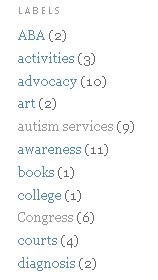
5. Labels are useful for navigating past articles and recurring themes on Autism Bulletin. Clicking on the "Congress" label, for example, will take you to a list of recent articles relating to that subject label.
6. You can always e-mail me at this address: michaelsgoldberg AT yahoo DOT com. Send comments, questions and suggestions and I will respond. Thanks for reading Autism Bulletin.
1. Search. You can search the archives of Autism Bulletin using the search bar at the top of this page. It looks like this:
 Just enter the text and click on "search blog" to see results of your search.
2. Comment. You can comment on any article by clicking on this "comments" word that appears beneath it. It looks like this:
 When you click on this a box will appear that asks you to type in some random letters. This act prevents automated web "bots" from adding nonsense comments to this website. You can use your name or post anonymous comments.
3. Share an article with a friend by clicking on the "forward" button which appears beneath every article and looks like this:
 A screen will appear asking you for your name and e-mail address and your friend's e-mail address. Click the "send e-mail" button and you're done.
4. Subscribe so that you receive new articles automatically. One way to do this is to enter your e-mail address in the box at right and click "subscribe." Another way to do this is by clicking on the orange icon which appears on the right side of this web page and looks like this:
 This icon is for RSS feeds which you can receive if you have a blog reader like Bloglines, which can be a useful for keeping all your website subscriptions in one place. Click on the icon and follow the instructions.
5. Labels are useful for navigating past articles and recurring themes on Autism Bulletin. Clicking on the "Congress" label, for example, will take you to a list of recent articles relating to that subject label.

6. You can always e-mail me at this address: michaelsgoldberg AT yahoo DOT com. Send comments, questions and suggestions and I will respond. Thanks for reading Autism Bulletin.
Wednesday, August 30, 2006
Safety Tips for Children with Autism
The latest newsletter from the Federation for Children with Special Needs, a Boston-based non-profit organization that provides support and information for parents of disabled kids, has an article with safety tips to help parents of children on the autism spectrum. (See page 14 for the article written by Karen Douglass, mother of a five-year-old boy with autism.)
The tips complement this two-page handout produced by Dennis Debbaudt, a Florida parent who has become an advocate and safety expert for people with autism and runs Autism Risk & Safety Management, which produces training videos for public safety agencies and educators. Debbault's materials are written with both children and adults in mind.
The tips range from simple steps to those that require some shoe leather and homework. As with any contingency planning exercise, some of the steps are sobering. They include:
Program an "ICE" telephone number into your mobile phone contact list. ICE stands for "in case of emergency" who should be called. This is a good idea for everyone, but as Douglass points out, it's vital in an emergency if you become incapacitated while with your autistic child.
Childproof your routes of exit. Families with young children on the autism spectrum should consider putting door latches out of reach. Douglass notes that her family also installed an alarm system that sounds if a door is opened, so her son won't leave the house unnoticed.
Prepare an information sheet about your child to share with public safety officials. Debbaudt's handout has a suggested list of details to include that go beyond name, physical description and photograph: all telephone numbers for parents and caregivers; atypical behaviors the child may do that will attract attention; favorite locations to visit; likes and dislikes when it comes to approaching the person; and method of communication, both verbal and non-verbal. Debbaudt also recommends preparing a map of dangerous locations near your home, including bodies of water.
Get to know the local police and fire department. If your child's wandering off is a concern, Debbaudt recommends contacting police, fire and ambulance services with this information, so they can flag it in their emergency response database. "When we provide law enforcement with key information before an incident occurs," he writes, "we can expect better responses." Visit the police and fire stations and emergency medical technician (EMT) station.
The advice extends to traffic safety. Douglass' town agreed to install signs at both ends of her street, alerting motorists to the fact that a special needs child lives in the neighborhood. She advocates that other parents do the same in their communities.
Get to know your neighbors. It's important for parents to do their best to educate neighbors and friends about their children. "If the neighbors know about the child's special needs, they are much more likely to act quickly if they see a child outside alone or in unsafe situations," Douglass says.
Tuesday, June 27, 2006
How to Plan a Community Outing with Your Autistic Child
It can feel like pulling off a successful community outing for a child with an autism spectrum disorder takes the knowledge of an autism expert and the skills of an experienced teacher of such children -- plus the logistical know-how of a presidential candidate's advance team. Here are some tips to make the trip less daunting.
1. Know your kid. Understand what motivates him. If he's young, does he love music and kids shows like Sesame Street? A touring musical stage show featuring Elmo and the gang could be worth a try. What kinds of activities, food, attractions, people does he prefer? Does he like the beach? Those "moon walk" bubbles? What gets him excited? (What gets him too excited?) What stresses him out? What does he need to feel comfortable? Who should be with him? (A sibling can be a comfort, but if grandma would be embarrassed seeing a loud tantrum in public, maybe she's not a good choice.)
2. Scout out the scene. What do you know about the venue? If it's at a local park, church, library, store, school or mall, it's easy to walk around and imagine what it will be like. If the outing is an event at a place unfamiliar to your child, what can you learn about the event? Is it likely to be crowded? Noisy or not, both in terms of audio and visuals? (Some stimulation can be good, but too much can be bad). If it's an arena or theater performance, is there a seating chart? Can you get reserved seats not at the front, but still close enough to see what's going on? Is there a place to walk around if the main event is proves too much to take? Where's the bathroom? How long is the walk from the exit to your transportation? When does it get crowded, and can you go to a venue at an off-peak time, where there are not so many people, like the first movie of the morning, or the last hour the gym is open?
3. Assess what your child could gain from attending. Maybe it's a chance to learn something new, or experience something with his family. Maybe it's to hear music she enjoys. Maybe it's to see his brother do something special. Whatever it is, there must be a real benefit for this child, that, I would argue, goes beyond sharing in family time. If it's a family event, make sure there's some experience with other family members that takes up part of the event that is just for him. It could be a game, or reading a book with him, or just playing together. If you don't know what is in this event for your child after analyzing the situation, you don't have to go. (If you feel like you do have to go, then bring along activities just for the child.)
4. Prepare the kid. Not everyone likes a surprise, and it can help to give a preview of what's coming up to your child with ASD. You can try writing a story (sometimes called a social story, there are lots of links if you search on Google) telling him what to expect. Social stories are especially useful for going to places like the doctor, dentist, a family dinner or school at the start of a new program.
With other activities, the child's reaction to the preview also can be a tip off to you about the activity's attraction. Example: the child likes Curious George books and loves the movie trailer on the web. This prompts his interest in going to see the movie, in spite of his dislike of crowds. It's a key factor in a successful outing. But when he's shown the movie trailer for Cars, he's clearly not as interested. So he doesn't go to see it. There are better things to do.
5. Celebrate small, partial victories. Even when doing all this advance prep work, it's unlikely that any event will be a purely wonderful experience. It's vital to appreciate the moments that do work, where your child loves a certain part of the experience -- one ride at the carnival, one song at the concert, one segment of the religious class, one treat at the birthday party. That moment where he's fully engaged in experiencing something, rather than shutting himself off from that potential enjoyment, can be thrilling to see.
6. Have an exit strategy. If things don't go well, and there will be times they won't, it's good to have one-on-one coverage -- mom or dad, for example -- to play defense. That way, you can try to persevere through a period when your child is uncomfortable, or stuck on something he sees but can't access (like a "moon walk" at the fair before it's open to kids). Use the tricks you use at home to calm and comfort your child, get him to focus on you and your voice and your words. The idea is to get him to avoid non-compliant behavior that will, in the end, prevent him from having any fun.
If that effort fails, and it sometimes will, hit the eject button and bail. You can try to persevere next time. (I know parents with more than one child who have brought two cars to an event as a contingency plan in case things don't work out. That way, one parent can stay at an event with the typically developing child, so she doesn't miss out.)
7. Don't give up. It's essential to keep trying, even after a failure. If one kind of event doesn't work, learn from what happened. What were the conditions there? Was the mall too crowded, noisy? When does it open, and is it quieter then? Did we give a good preview of what to expect? Did the child expect something else? Did we expect something else? Are the child's preferences changing? It could even have been a bad day. We all have them.
The point is to look for opportunities to have great ones. Try again.
Subscribe to:
Posts (Atom)


